 q4WsCvLajdd4

Where a steep stream leaves a mountain valley and enters a flatter basin, its sediment may spread into a fan-shaped deposit. These alluvial fans can be seen in dry regions, glaciated valleys and many other settings where channels lose confinement. Their form records repeated changes in water flow, sediment supply and the route taken by channels across the fan. A fan is not simply a pile left by one flood; it is a landscape built through many episodes.
Why a fan forms
In a narrow valley, a stream is confined between slopes and can carry sediment along a channel. At the valley mouth, the gradient often decreases and the flow spreads out. The stream may lose some of its ability to transport coarse particles, depositing gravel and sand. Later flows can cut a new channel, abandon an older one and spread sediment across another part of the fan.
Some fans are built mainly by water-rich floods; others receive debris flows, landslides or sediment-laden runoff. The relative importance of these processes depends on climate, slope, vegetation, sediment supply and the geology of the catchment. Fan shape alone cannot identify the process that built it.
Read the fan from apex to toe
The fan apex lies near the mountain-front outlet, while the toe marks its distal margin. A fan may show channels radiating outward, shallow lobes, gravel bars or subtle ridges. Coarse deposits are often concentrated near the apex, but sediment size can vary sharply across the surface. The fan may also be dissected by a river that has cut into older deposits.
Describe what is visible before interpreting it: channel width, surface gradient, sediment size, sorting, clast shape, vegetation and evidence of erosion. A fan with several abandoned channels may record shifting flow paths, but the channels could have formed during different periods and under different conditions.
Water floods and debris flows
Water floods commonly sort sediment as flow strength changes. Gravel may accumulate in channel bars while sand and finer material settle farther away or during waning flow. Debris flows contain a dense mixture of water, mud, gravel and boulders; they can deposit poorly sorted material and may leave lobate fronts or levees. However, later runoff can rework a debris-flow deposit, creating a more sorted surface.
Field evidence should be combined. Look for matrix-supported clasts, sorting, grading, surface lobes and channel relationships, but avoid treating any one feature as conclusive. A deposit can be modified after emplacement, and a single fan may contain both flood and debris-flow deposits.
Fans preserve changes through time
Repeated deposition can bury older surfaces, while incision can expose a fan’s internal layers. A terrace-like bench along a channel may be an abandoned fan surface. If a stream cuts down through the fan, the incision may reflect a change in base level, sediment supply, water discharge or tectonic movement. Distinguishing among these possibilities requires more than the fan’s outline.
Dating buried soils, charcoal or suitable minerals can constrain when a surface formed, though each method has limits. Relative relationships are often useful too: a channel that cuts a deposit is younger than the deposit, while a layer that fills an older channel is younger than that channel. A clear stratigraphic sequence can reveal multiple phases of fan growth.
Mountain-front controls
The size and shape of a fan depend partly on its source catchment. A large steep basin may deliver more sediment than a small, gently sloping one. Resistant bedrock can supply coarse blocks; weak or highly fractured rock may produce abundant finer debris. Vegetation and rainfall influence how readily sediment moves from slopes into channels.
Fans can also be affected by tectonics and changes in regional drainage. Uplift may steepen channels or alter the basin’s base level, while subsidence can create space for sediment to accumulate. These controls may operate over long periods, but a fan can also change rapidly after a single extreme event.
Interpret with care
For a field description, map the apex, toe, active channels and abandoned surfaces. Record sedimentary structures and relationships between deposits. Distinguish observed evidence from inferred processes, and note whether the fan is active, dissected or partly covered by vegetation. Avoid standing in active channels or beneath unstable fan-head slopes during storms.
Alluvial fans are valuable because they connect processes in steep catchments with the record preserved on basin floors. Their geometry offers a starting point, but the strongest interpretation comes from sediment, stratigraphy and landscape context together. Read that evidence carefully and a fan becomes a history of changing flow paths, sediment supply and mountain-front evolution.
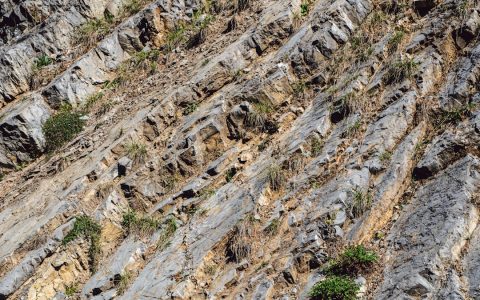
Image: Folded rock landscape at Vasquez Rocks. Photo by Jose Hernandez-Uribe / Unsplash; illustrative mountain-front geology.