 q4WsCvLajdd4
At many outcrops, fresh rock grades upward or outward into cracked, discoloured and eventually soil-like material. This vertical or lateral sequence is a weathering profile: a record of how rock responds to water, air, organisms and changing physical conditions near Earth’s surface. It can help explain why landscapes erode at different rates, why soils vary across a slope and why an apparently solid rock may be weak beneath its outer skin.
Weathering is not the same as erosion
Weathering breaks down or alters rock in place. Erosion removes and transports the resulting particles or dissolved material. The two processes often operate together, but separating them helps interpret a profile. A rock can be deeply weathered while remaining in place; a stream can then carry the loose material away and expose a new surface.
Physical weathering changes the size or fracture state of rock without necessarily changing its minerals. Chemical weathering changes mineral composition through reactions with water, oxygen, acids and other substances. Biological activity can contribute to both, for example when roots widen cracks or organisms alter local chemistry. Most natural profiles record several processes acting over time.
Look for changes across the profile
Begin by identifying the least altered rock visible, then move toward the more weathered material. Record colour, fracture spacing, hardness, grain cohesion and whether original structures remain visible. A profile may contain a fractured zone, a saprolite in which rock fabric is preserved but minerals are altered, and soil in which the original rock structure is less obvious. These boundaries are not always sharp, and local terminology varies.
Colour can provide clues but is not a diagnosis. Red or yellow staining may reflect iron oxidation, while pale zones can result from mineral loss or leaching. Dark coatings may be organic or mineral. Use the colour as a description and test it against texture, mineralogy and setting rather than assigning a process immediately.
Minerals respond differently
Silicate minerals do not all weather at the same rate. Feldspars can alter to clay minerals under suitable conditions, while quartz is often more resistant and may remain as grains after other minerals have changed. Carbonate minerals can dissolve readily in weakly acidic water. The actual sequence depends on temperature, water availability, drainage, acidity and the composition of the parent rock.
As minerals alter, the material may become more porous and easier for water to enter. This can accelerate further reactions, but the profile may also become less permeable if clay accumulates and blocks pores. The relationship between weathering and water movement is therefore not always a simple increase in intensity with depth.
Climate and topography matter
Warm, wet conditions can favour rapid chemical reactions, while freeze-thaw cycles may contribute to physical breakdown where water repeatedly freezes in cracks. Yet climate alone does not determine profile thickness. A steep slope may lose weathered material quickly, leaving a thin cover over fresh rock. A stable, gently sloping surface may retain a deeper profile. Drainage, vegetation, rock type and past climate also matter.
Two nearby profiles can differ because one lies on a ridge and the other in a hollow, or because one is better drained. A deep profile does not automatically mean the site is currently weathering rapidly; it may have accumulated over a long period under conditions different from today.
Record evidence without overclaiming
A field description should note the location and orientation of the exposure, the visible profile boundaries, changes in texture and colour, fracture density, and any relation to bedding or joints. Estimate thickness only where the full interval is visible. If the base is covered, state that the profile continues beyond the exposure. Avoid digging into unstable slopes or collecting material where permission is required.
Photographs are most useful when they show the whole profile and close views of diagnostic changes. Keep a scale in the same plane as the feature. A sketch can show how weathering follows fractures or varies across the slope. If the exposure is disturbed by road construction or landscaping, note that context because human activity may have altered the original sequence.
Why profiles matter
Weathering profiles influence slope stability, groundwater recharge, soil development and the supply of sediment to rivers. Engineers need to know whether a foundation rests on fresh rock or altered material; geomorphologists use profiles to understand how hillslopes evolve; soil scientists examine how parent material contributes to soil properties. The profile is therefore both a geological archive and a practical part of the landscape.
The key is to read the profile as a sequence of observations. Identify what has changed, consider the processes that could produce those changes, and acknowledge the role of climate, drainage and time. That approach turns a weathered outcrop into evidence of the long interaction between rock and the surface environment.
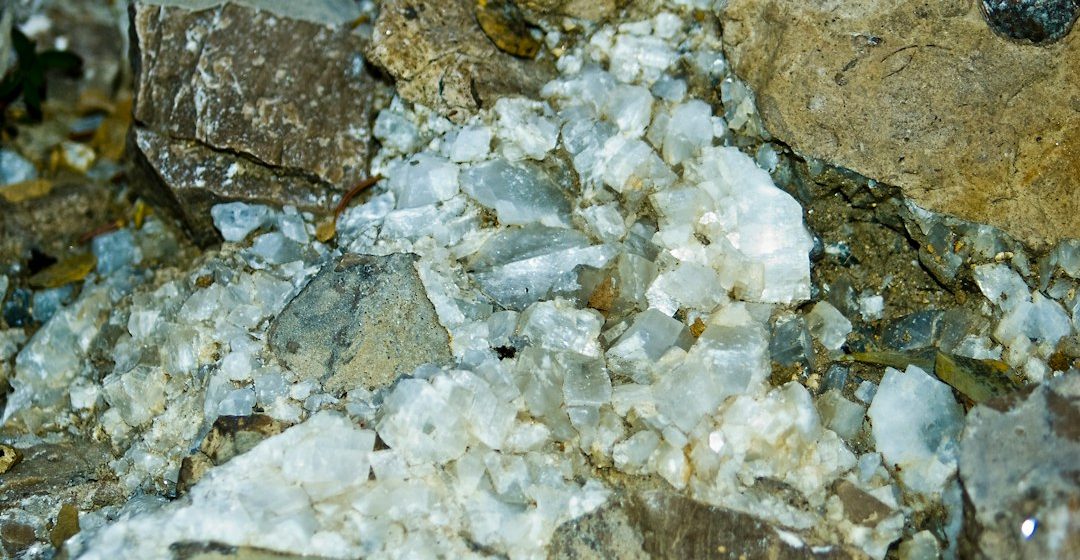
Image: Calcite crystals on a rocky river shore. Photo by Alan Emery / Unsplash; illustrative mineral-weathering image.