 q4WsCvLajdd4
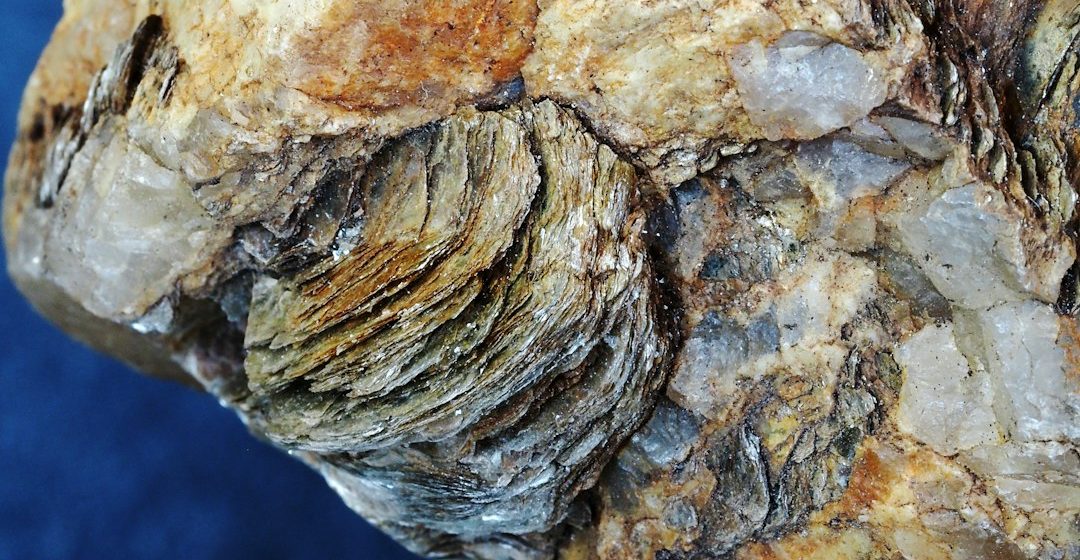
Metamorphic rocks are often recognised by the way their minerals are arranged, not simply by the minerals they contain. A slate may split into thin sheets, a schist may glitter with aligned mica, and a gneiss may show alternating light and dark bands. These patterns—known collectively as metamorphic fabric—record how a rock responded to heat, pressure and deformation. Learning to describe fabric helps students move from naming a specimen to reconstructing the processes that shaped it.
What fabric describes
Fabric is the spatial arrangement of grains, crystals, clasts and other features in a rock. In metamorphic rocks, it may include a preferred mineral alignment, a planar layering, a lineation or a combination of these. A foliation is a planar fabric; a lineation is a linear one. The terms describe geometry first. They do not, by themselves, reveal the exact pressure, temperature or direction of tectonic movement.
Fabric develops in several ways. Platy minerals such as mica may rotate or grow with their flat surfaces roughly parallel. Elongate minerals can become aligned, while compositional layers may be folded, transposed or newly formed during recrystallisation. The resulting pattern depends on the starting rock, the minerals present and the conditions during deformation.
From slate to schist
Slate commonly has very fine grains and a closely spaced slaty cleavage. Its minerals are too small to identify individually without magnification, but the rock splits along a consistent planar fabric. Phyllite is typically finer than schist and may show a silky sheen as small mica grains grow. Schist contains larger visible platy or elongate minerals, often producing a strong schistosity. These names describe texture and fabric, not a simple ladder that every rock must climb.
Gneissic banding differs from schistosity. It is a compositional layering, commonly with light-coloured quartz- and feldspar-rich bands alternating with darker mineral-rich bands. Such banding may develop through metamorphic differentiation, deformation of older layers or inherited sedimentary and igneous structures. A photograph can show the pattern, but field context is needed to decide which explanation is plausible.
Reading lineation carefully
Lineation can form from aligned amphibole, stretched pebbles, mineral aggregates or the intersection of two planar fabrics. Its orientation may preserve a stretching direction, but not every lineation records the same movement. A mineral lineation in a strongly deformed rock may be associated with transport, while an intersection lineation can simply mark where two surfaces meet.
Record lineation with a compass and clinometer when the feature is clear. Note whether it is mineral-defined, formed by stretched objects or created by intersecting surfaces. Do not assume that the line points toward the direction of tectonic transport without supporting structures.
Measure, then interpret
A useful description separates observation from interpretation. First record the fabric type, spacing, mineral size, continuity and relationship to compositional layers. Measure orientation using a consistent convention. Then look for folds, shear bands, mineral growth overprinting an older fabric, or veins that cut across it. Cross-cutting relationships can establish relative order: a vein that cuts foliation is younger than that foliation, while a folded foliation predates the fold that bends it.
Weathering can exaggerate or obscure fabric. A surface may split along joints rather than foliation, and a banded outcrop can appear uniform when viewed from the wrong angle. Inspect more than one surface where permitted and use a scale in photographs. In a hand sample, note whether the fabric continues around the specimen or is only visible on one face.
What fabric cannot tell you alone
Similar fabrics can form under different conditions. Mineral alignment reflects both the rock’s composition and its deformation history. To estimate metamorphic conditions, geologists combine fabric with mineral assemblages, mineral chemistry, field relationships and, where available, geochronology. A schist with garnet may preserve evidence of changing conditions, but the presence of garnet alone is not a unique pressure-temperature indicator.
The same caution applies to tectonic setting. Foliation is common in many deformed regions, but it does not automatically identify a collision zone, a subduction zone or a particular shear direction. The strongest interpretation is the one that explains several independent observations.
A repeatable student description
Begin with rock type and grain size. Describe whether the fabric is planar, linear or banded; identify the minerals that define it if possible; record orientation and spacing; and note any folds, veins or overprinting relationships. Finish with a cautious interpretation and list what remains uncertain. That sequence makes a field or laboratory description clear enough for another reader to check.
Metamorphic fabric is a record of a rock’s response to changing conditions, but it is not a complete history by itself. Treating it as measurable evidence—rather than a label—makes the interpretation more accurate and reveals how much geological information can be preserved in the arrangement of ordinary mineral grains.
Image: Muscovite mica in pegmatite granite. Photo by Walter Bonnici / Unsplash.