 q4WsCvLajdd4
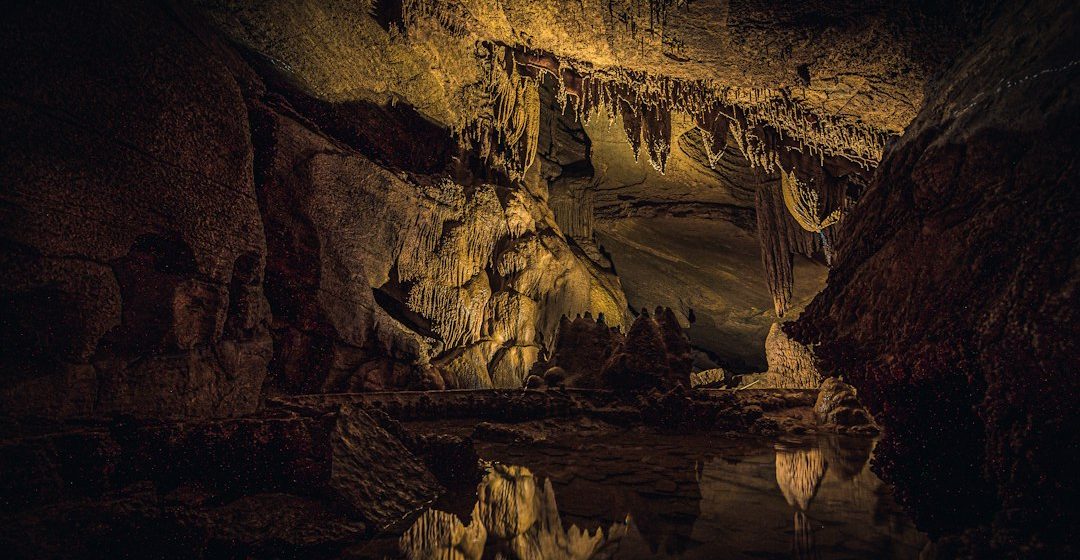
A cave can appear to be a quiet, unchanging place, yet its mineral formations record changes at the surface above it. Stalactites, stalagmites and flowstone grow as mineral-rich water moves through limestone and enters an underground opening. Their shapes are striking, but their value to geologists goes further: some cave deposits preserve chemical and physical clues about past rainfall, vegetation and climate.
How cave formations begin
Rainwater absorbs carbon dioxide from the atmosphere and, especially, from soil. The slightly acidic water moves through cracks in limestone and dissolves a small amount of calcium carbonate. When this water reaches a cave, pressure and carbon dioxide conditions change. Some carbon dioxide escapes into the cave air, allowing calcium carbonate to precipitate as a thin mineral layer.
Repeated drops can build a stalactite down from a ceiling. Water that lands on the floor may leave a deposit that grows upward as a stalagmite. Where water spreads across a sloping surface, it can form flowstone. These features are collectively known as speleothems. Their growth is usually slow, and the rate varies with water supply, cave ventilation, chemistry and the shape of the surface.
Why layers matter
Many speleothems develop visible or microscopic growth layers. A layer may represent a period of mineral deposition, but it is not automatically an annual band. Some caves preserve seasonal changes, while others grow irregularly or pause for long intervals. Geologists first establish the sequence of layers and then test whether the pattern reflects time, changes in water chemistry or interruptions in growth.
Thin sections and imaging can reveal changes that are difficult to see with the naked eye. Crystal size, impurities and growth surfaces may indicate shifts in drip rate or cave conditions. A clean-looking band is not necessarily a simple climate signal; the cave’s hydrology can filter and alter the water before it reaches the deposit.
Reading oxygen and carbon isotopes
Scientists often measure stable isotopes of oxygen and carbon in speleothem calcite. Oxygen isotope values can be influenced by the isotopic composition of rainfall, temperature and the amount of evaporation before water enters the cave. Carbon isotope values may respond to soil activity, vegetation, water-rock interaction and changes in how long water remains in the limestone.
These signals are useful because they can be compared with other climate records. However, neither isotope is a direct thermometer or rain gauge on its own. A change may reflect several processes at once. Researchers interpret the measurements alongside cave monitoring, local geology, modern rainfall and independent records such as lake sediments or marine cores.
How scientists establish an age
Many cave carbonates contain small amounts of uranium but very little initial thorium. Over time, uranium decays through a series of steps that produces thorium. Measuring uranium and thorium isotopes can provide an age estimate for a suitable layer, often using uranium-thorium dating. The method is especially valuable for deposits that are too young or too old for radiocarbon dating to be the best choice.
Dating is not automatic. Open-system behaviour, detrital contamination and later recrystallisation can affect the result. Scientists screen samples, inspect their textures and report uncertainty. A reliable chronology is essential before a sequence of chemical changes can be linked to a particular climate interval.
From one cave to a regional story
A single cave record reflects local conditions. A blocked passage, a change in vegetation or a shift in the route taken by groundwater can alter the deposit without a major regional climate change. To build a wider picture, researchers compare records from several caves and with independent archives. Agreement between different sites increases confidence that a signal is regional rather than local.
Speleothems can also preserve gaps. If a cave becomes too dry, mineral growth may stop. A hiatus is evidence that the record is incomplete, not proof that the climate was stable. Recognising missing intervals is just as important as interpreting the layers that remain.
A careful way to read a natural archive
For students, the main lesson is to move from observation to explanation in stages. Identify the type of deposit, describe its layers and texture, establish its age, and then ask which environmental processes could have produced the measured signal. Consider alternative explanations before drawing a conclusion. This approach turns a beautiful cave formation into a scientific record that can be tested and compared.
Speleothems are valuable because they connect surface water, soil, limestone and cave conditions in one archive. Read carefully, they help reconstruct environmental changes that may not be preserved in nearby surface deposits. Their story is written slowly, one mineral layer at a time.
Image: Cave interior illustrating underground carbonate environments. Photo by Jed Owen / Unsplash.