 q4WsCvLajdd4
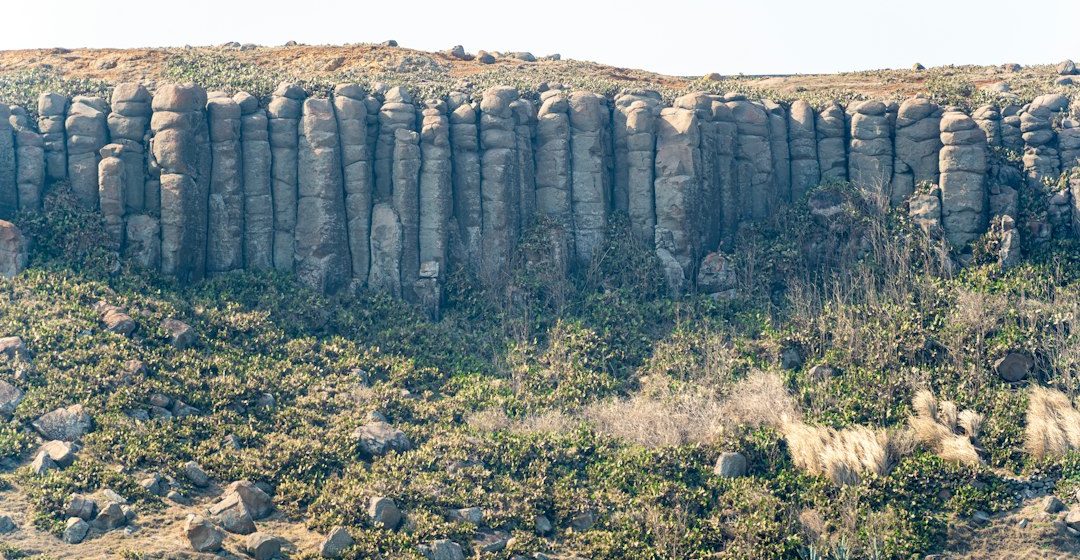
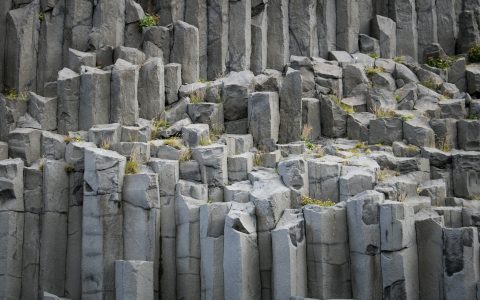
Some volcanic landscapes look almost architectural. Long, polygonal columns stand side by side, creating cliffs and platforms that resemble carefully stacked stone. These features are known as columnar joints. They are especially familiar in basalt, although similar structures can develop in other cooling materials.
Cooling creates stress
When lava or a shallow magma body cools, it contracts. The outer parts generally lose heat before the interior, producing a moving boundary between cooler solid rock and hotter material. As contraction continues, tensile stress builds. Rock is strong under compression but comparatively weak under tension, so fractures can form to relieve that stress.
In a cooling lava flow, cracks commonly begin at a cooling surface and advance inward. The resulting fracture network divides the rock into columns oriented broadly perpendicular to the cooling surface. In a lava flow cooling from both top and bottom, two fracture fronts may grow toward one another.
Why do the columns look hexagonal?
Column cross-sections are often polygonal, with five- to seven-sided shapes common and six-sided patterns especially recognisable. A hexagon is an efficient way to divide a plane into similar cells, but nature does not produce a perfect geometric grid. Local differences in cooling rate, rock composition, thickness and pre-existing cracks create irregular polygons.
The important process is not that the rock somehow “chooses” a hexagon. Instead, fractures interact and propagate through a cooling body. The pattern evolves as the material contracts and stress is redistributed. The result is a network of columns that may vary in width and regularity from one part of an exposure to another.
Column size records cooling conditions
Column diameter is influenced by how quickly heat is removed and by the properties of the material. In many settings, slower cooling is associated with wider columns, while faster cooling can produce narrower fracture spacing. This relationship is not a universal measuring rule, because thickness, composition, water availability and heat transfer all matter.
Cooling conditions may vary vertically and laterally. Near a chilled margin, columns can be small and irregular. Farther into a thick flow, they may become larger and more regular. Geologists use these patterns alongside mineral textures and field relationships to interpret how a lava body cooled.
Basalt is common, but not the only example
Basaltic lava is well suited to producing columnar jointing because thick flows can cool slowly enough for organised fracture patterns to develop. Famous examples occur in volcanic provinces and at coastal cliffs where erosion has exposed the internal structure of flows. Columnar joints can also form in some andesitic and rhyolitic rocks, and in certain non-volcanic materials that contract as they cool or dry.
How to read a columnar outcrop
When examining a site, first identify the orientation of the columns. Are they vertical, inclined or curved? Their direction can help indicate the geometry of the cooling surface, although later deformation and complex flow shapes can complicate the picture. Look for changes in column diameter, the presence of horizontal fractures and the relationship between columns and the boundaries of the rock body.
Also distinguish columnar joints from sedimentary layering. Columns are fractures that divide a once-continuous rock mass; they are not separate layers deposited one after another. A weathered outcrop may obscure this distinction, so inspect several surfaces where possible.
A record of heat loss
Columnar jointing turns a physical process into a visible geological pattern. The columns preserve clues about contraction, heat transfer and the geometry of cooling. Their remarkable appearance is a reminder that familiar landscapes can reveal the invisible processes that operated deep within a lava flow long before erosion exposed them.
Image: Basalt rock formation. Image credit: Winston Chen / Unsplash.