 q4WsCvLajdd4
A mineral grain smaller than a fingernail can preserve evidence from billions of years ago. Zircon, a common accessory mineral in many igneous rocks, is valued by geologists because it can incorporate uranium when it crystallises while usually excluding lead. That makes it especially useful for investigating the ages and histories of ancient rocks.
Why zircon is such a useful time capsule
Zircon has the chemical formula ZrSiO4 and a robust crystal structure. It commonly forms in silica-rich magmas, although it can occur in a wide range of igneous and sedimentary settings. Its resistance to weathering and many metamorphic conditions means that grains can survive after their original host rock has been eroded.
As a crystal grows, uranium atoms can enter its structure, while initial lead is generally limited. Over time, uranium isotopes decay into lead at known rates. By measuring uranium and lead isotopes in a carefully selected part of a zircon grain, scientists can estimate when that part crystallised.
How uranium-lead dating works
Two uranium isotopes are particularly important: uranium-238 decays to lead-206, and uranium-235 decays to lead-207. Because the two decay systems operate at different rates, comparing them provides a powerful check on the reliability of an age. Modern laboratories commonly analyse tiny areas of individual crystals using specialised instruments.
Real zircon grains can be complicated. A crystal may contain an older inherited core surrounded by younger growth zones. Later heating or fluid interaction can disturb parts of the isotopic system. Researchers therefore examine crystal textures and chemical composition, often using imaging before selecting analytical spots.
Inherited grains reveal older material
Some magmas incorporate fragments of older crust as they rise or evolve. Zircon crystals from that older material may survive inside the younger igneous rock. These inherited grains show that the magma interacted with pre-existing continental material, even if the host rock itself is much younger.
Sedimentary rocks provide another opportunity. A sandstone may contain zircon grains eroded from several source regions. The range of grain ages can help identify possible source terrains and reconstruct ancient sediment pathways. This approach is known as detrital zircon geochronology.
What zircon can—and cannot—tell us
Zircon ages are often described as the age of a rock, but that wording needs care. A crystallisation age may date the formation of a mineral in magma, not necessarily the time when the entire rock was deposited, deformed or exposed at the surface. In sedimentary rocks, the youngest reliable detrital zircon grains can constrain the maximum depositional age, but they do not usually provide the exact date of sedimentation.
Geochemists also study trace elements and oxygen isotopes in zircon. These measurements can offer clues about the magma’s source, the involvement of older crust and the conditions under which crystals formed. Such interpretations depend on context and should be tested against other minerals and field relationships.
Why the mineral matters for early Earth research
Much of Earth’s earliest crust has been recycled by melting, erosion, metamorphism and plate tectonics. Very old zircon grains can survive in younger rocks even where the original crustal bodies no longer exist. They provide rare fragments of evidence about early crust formation and the evolution of Earth’s surface environments.
However, a single ancient grain cannot describe an entire vanished continent. Researchers compare many grains, their internal zones, chemical signatures and geological settings. The strongest conclusions emerge from datasets that connect mineral-scale evidence to regional geology.
A small crystal, a long history
Zircon is powerful because it combines durability with a measurable radioactive clock. It does not preserve every event, and its record can be complex, but it allows scientists to investigate episodes of crust formation that would otherwise be difficult to date. In that sense, each grain is a small archive—one that must be read carefully and in context.
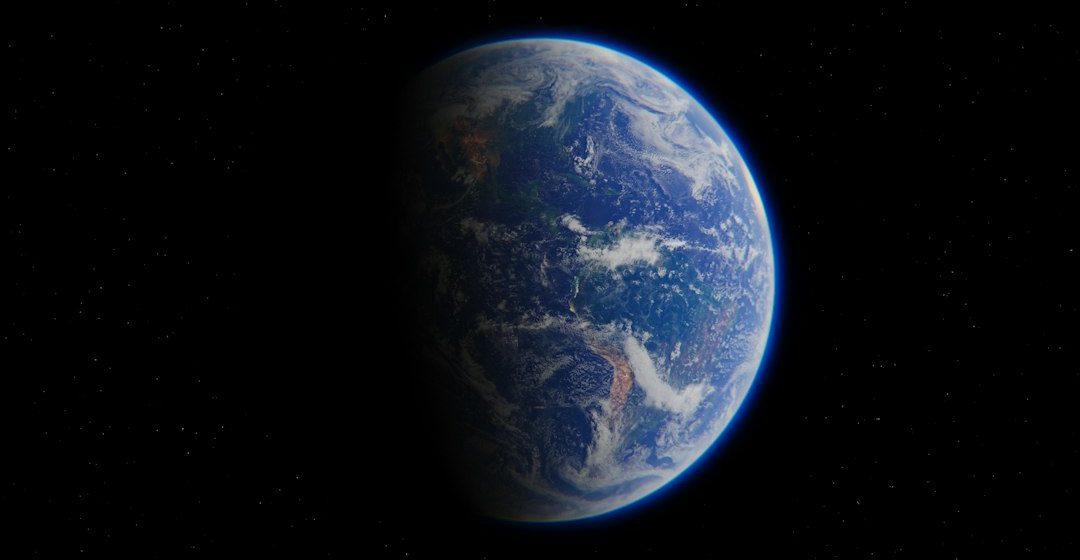
Image: Scientific illustration of planet Earth. Image credit: dlovan 666 / Unsplash.